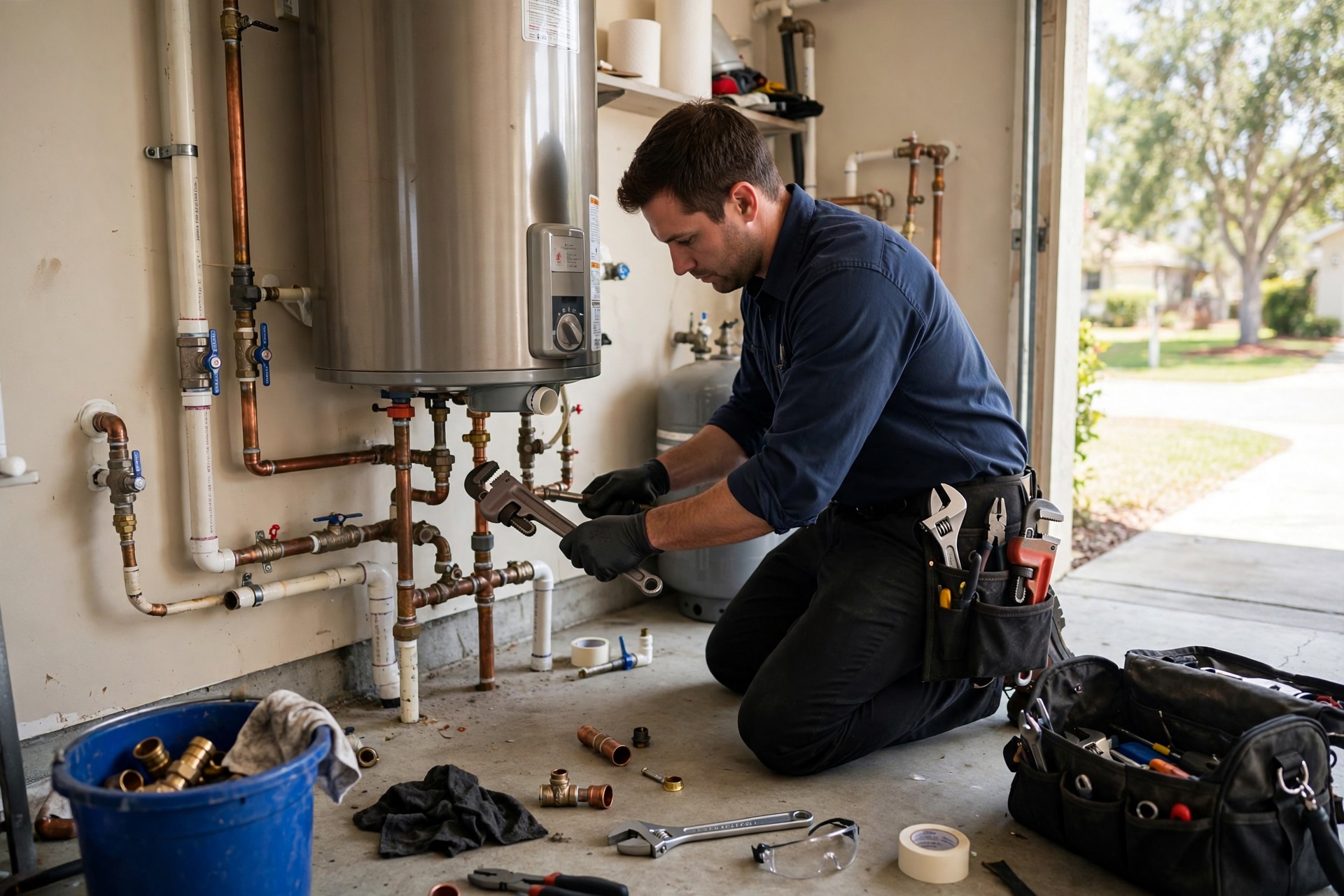
Rockledge homes in neighborhoods like Indian River City and along Historic Rockledge Drive often contain tanks installed 15 to 25 years ago that now face accelerated internal corrosion from the area's humid subtropical climate. Hot summers drive higher hot-water demand while the proximity to the Indian River Lagoon increases airborne moisture that attacks anode rods and electrical components faster than in drier inland counties. Technicians routinely find sediment buildup that reduces efficiency and trips high-limit switches, especially in Cocoa Isles properties where well water or older municipal lines carry higher mineral content.
Electric element failures appear frequently during the warm season when continuous use exposes weak spots in lower-wattage elements common to 1980s and 1990s installations. Gas models in Rockledge Estates require careful inspection of the thermocouple and gas control valve because salt air from the lagoon can corrode burner assemblies and create delayed ignition. Replacement decisions must account for space constraints in many single-story Brevard County homes where tankless units need additional venting that may not align with existing roof penetrations near Rockledge Park.
Code compliance in Brevard County now requires expansion tanks on all new closed-loop installations, a detail missed in some earlier replacements that leads to pressure-relief valve leaks. When a unit fails during peak summer humidity, homeowners in Cocoa and nearby Melbourne often discover that the original electrical circuit lacks the amperage needed for modern high-efficiency models, requiring panel upgrades before the new heater can be energized.
Technician insight
In Rockledge the thing that catches most people out with Water Heater Repair & Replacement is how quickly the Indian River Lagoon humidity eats through anode rods in tanks over fifteen years old, especially in Indian River City homes that still have the original electric units from the 1990s.
Failed Lower Element in Rockledge Estates
A homeowner in Rockledge Estates reported lukewarm water only during morning showers. Inspection showed the lower element had failed due to sediment and the anode rod was fully depleted. The technician replaced both elements, installed a new anode, and flushed the tank, restoring full capacity without needing a full replacement.
Water Heater Repair & Replacement Services We Offer
✓Electric Element Repairs
Replace burned-out upper or lower elements and test thermostats on electric tanks common in Rockledge Estates homes.
✓Gas Control Valve Repairs
Diagnose and replace faulty gas valves and thermocouples on natural-gas water heaters serving Indian River City properties.
✓Residential Water Heater Installation
Remove old tanks and install code-compliant new units with expansion tanks and proper venting for Rockledge single-story homes.
✓Sediment Flush and Maintenance
Flush mineral buildup from tanks to restore efficiency in areas with lagoon-influenced water supplies.
✓Thermostat Replacement
Install new upper and lower thermostats to fix temperature fluctuations reported in older Cocoa Isles residences.
✓Tankless Water Heater Conversion
Evaluate and convert traditional tank systems to tankless units when space or efficiency demands change in Brevard County homes.
Water Heater Repair & Replacement Cost in Rockledge, FL
| Service | Typical Range | What Affects It |
|---|---|---|
| Electric Element Replacement | $225–$375 | Price varies with access and whether both elements need replacement. |
| Gas Valve Service | $275–$450 | Includes thermocouple when required; older valves in humid areas often need full replacement. |
| Standard Tank Replacement | $1,450–$2,200 | Depends on gallon size, venting type, and whether electrical upgrades are needed. |
| Sediment Flush | $125–$195 | Recommended annually for lagoon-area homes with higher mineral water. |
Ranges are typical for Rockledge, FL and confirmed with an exact written quote before any work starts.
How it works
- 1
Initial Assessment
Arrive within the service window, shut off water and power or gas, and document tank age and leak locations.
- 2
Component Testing
Check elements, valves, and thermostats with multimeter and pressure gauges to isolate the failure point.
- 3
Repair Or Replace Decision
Review findings with the homeowner and provide options based on tank condition and local code requirements.
- 4
Installation And Testing
Complete the chosen work, refill the system, purge air, and verify temperature and pressure settings before departure.
Pricing
Upfront written quotes provided before any work begins.